Best Heavy Duty Dust Collector When Shop Space Is Tight
Five dust collection picks compared on airflow claims, filter micron ratings and footprint, with a clear winner for cramped garage shops and honest notes on which ones are only parts.

By Dane PruittUpdated 15 min read
On this page
- Best heavy duty dust collector for woodworkers at a glance
- Which buyer does each of these five actually suit?
- 1. WEN Woodworking Dust Collector — Best overall
- 2. Rockler Dust Right 650 CFM Wall Mount Dust Collector — Best premium
- 3. Rockler Dust Right Dust Separator — Best minimal setup
- 4. 70 Gallon Dust Collector Bag — Best for pros
- 5. Hagsfire Table Saw Dust Collector Bag — Best budget pick
- Micron ratings: the number that decides your lungs
- Whole units versus parts: what you're really buying
- How much floor space does a dust collector need?
- What owning one actually involves
- The verdict
- FAQ
The best heavy duty dust collector for woodworkers is the WEN DC3474, which pairs a 7.4-amp induction motor with a 9-inch impeller that WEN says moves up to 600 cubic feet of air per minute, all inside a 43.3 x 17.7 x 20.1 in frame. If your floor is already full, Rockler's Dust Right 650 CFM wall-mount unit trades collection volume for vertical real estate. Getting this wrong is expensive in a way you won't notice for a year.
Best heavy duty dust collector for woodworkers at a glance
| Pick | Airflow claim | Filtration | Price |
|---|---|---|---|
Best overall WEN Woodworking Dust Collector |
600 CFM claim | 5-micron bag | Check Price |
Best premium Rockler Dust Right 650 CFM Wall Mount |
650 CFM claim | 30-micron bag | Check Price |
Best minimal setup Rockler Dust Right Dust Separator |
Uses your shop vac | Cyclone pre-separation | Check Price |
Best for pros 70 Gallon Dust Collector Bag |
Matches host unit | Fabric bag, no rating given | Check Price |
Best budget pick Hagsfire Table Saw Dust Collector Bag |
Gravity only | Heavy duty canvas | Check Price |



Which buyer does each of these five actually suit?
This set splits into two groups, and the split matters more than any airflow figure. Two picks are machines. Three are parts that make a machine you already own work better.
Sort yourself before you shop:
- You own nothing and cut with a table saw and planer. The WEN DC3474 is your starting point. It's a complete unit with a 4-inch port, a mobile base and a 15-gallon bag.
- You own nothing and your floor is full. The Rockler wall-mount unit goes up on keyhole slots instead of taking a corner.
- You own a shop vac and mostly work with a router and sander. The Rockler Dust Right separator turns that vac into a two-stage extractor.
- You own a 70-gallon single-stage collector with a split bag. The 20-inch replacement bag is the whole answer.
- You own an open-stand contractor saw and nothing else. The Hagsfire canvas bag catches gravity-fed chips and costs the least of the five.
Note what the keyword promises and what Amazon returned. "Heavy duty" is a marketing word here, not a specification, and none of these five publishes a static-pressure figure or a duty rating you could hold them to. That's normal in this corner of the market. Judge them on the numbers they do publish: motor amperage, impeller diameter, port size, micron rating and footprint. Those are checkable. "Heavy duty" isn't.
1. WEN Woodworking Dust Collector — Best overall
The most complete unit here for a single-operator garage shop, with the only published warranty in the set.

Best for: a one-person garage shop with a table saw and planer Skip it if: you need finer than 5-micron filtration out of the box
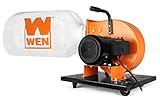
Two things separate the DC3474 from everything else in this comparison. First, WEN publishes a two-year warranty, and it's the only pick here that publishes one at all. Second, it's the only unit that combines a stated motor rating with a stated filter rating: a 7.4-amp induction motor and a 5-micron zippered bag. WEN claims the 9-inch impeller moves up to 600 cubic feet of air per minute.
The 5-micron bag is the quiet reason this wins. Compare it to the 30-micron bag on the Rockler wall-mount, which is six times coarser, and the difference lands squarely on the fine sanding dust that hangs in the air after you've swept up.
Setup flexibility is real too. WEN lists swivel casters, an onboard carrying handle and optional wall mounting, so you can roll it to whichever tool you're using or hang it and run rigid duct. At 41.1 pounds it's the heaviest thing here, and the 43.3-inch height means a low bench or a shelf overhang will get in the way.
The trade-off against the Rockler premium pick is footprint. This one wants floor, and 17.7 x 20.1 in of it, plus swing room for the bag zipper. It also sells faster than the other collector here, which tells you something about where most buyers land.
Pros:
- 5-micron bag, the finest published rating in this set
- Two-year warranty, the only one stated here
- 7.4-amp induction motor with 9-inch impeller
- 4-inch port fits standard woodworking tool outlets
- Casters plus optional wall mount
Cons:
- 41.1 pounds, heaviest pick here
- 43.3-inch height blocks low-shelf placement
- 15-gallon bag fills fast on a planer
- Only one seller lists it
- 5 micron still passes the finest airborne dust
2. Rockler Dust Right 650 CFM Wall Mount Dust Collector — Best premium
The highest airflow claim in the set, mounted vertically so it never costs you a square foot of floor.
Best for: shops with wall space but no floor space Skip it if: you sand indoors and won't buy the canister upgrade
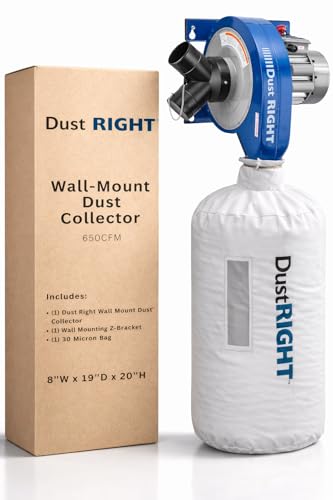
Rockler puts this at 650 CFM, the highest airflow claim among these five and 50 CFM above the WEN. It's also the most expensive pick here, and the reason is the mounting design rather than the motor. Keyhole slots and an included Z-bracket let the whole unit hang on a stud wall, vertical and out of the traffic path.
That geometry is genuinely useful in a two-car garage where the car still parks. Rockler says the unit supports multiple tools at once, and a wall-mounted collector is much easier to feed with fixed duct runs than a rolling one you keep repositioning.
Here's the catch, and it's a big one. The included bag is rated at 30 microns. That's coarse enough to catch chips and shavings while letting the fine, lung-depositing dust straight back into the room. Rockler is upfront about it and offers a 1-micron canister upgrade, so treat that upgrade as part of the purchase rather than an option. The clear bag with a bottom zipper does make it obvious when you're full.
Against the WEN, you're paying more for a coarser filter and a better footprint. Whether that's a good trade depends entirely on your wall.
Pros:
- 650 CFM claim, highest in this set
- Wall-mount keyhole slots and Z-bracket included
- Clear bag with viewing window and bottom zipper
- Upgradeable to a 1-micron canister
- Frees floor space entirely
Cons:
- 30-micron bag is the coarsest filtration here
- Most expensive pick, and the canister costs more again
- No published warranty
- Needs solid stud wall, not drywall alone
- Slowest seller of the picks with sales data
3. Rockler Dust Right Dust Separator — Best minimal setup
The cheapest route to two-stage separation if you already own a shop vac you like.

Best for: anyone already running a shop vac they like Skip it if: you want a single-hose solution with no extra bucket
This isn't a collector. It's a cyclone that sits between your shop vac and your tool, and it changes how the vac behaves. Rockler says any shop vacuum with a 2-1/4 inch ID outlet becomes a two-stage extractor, dropping chips and heavy dust into the 10-gallon bucket before they ever reach your vac filter.
The payoff is suction that doesn't collapse mid-cut. A pleated shop vac filter clogs within minutes on planer shavings, and once it clogs, your airflow is gone. Rockler's pitch is filter and impeller life, and the mechanism behind that pitch is sound: separate the heavy stuff by cyclonic airflow and the filter only sees fines.
The bucket is translucent, so you can see the fill level without opening anything, and the five-caster base makes it stable enough to drag by the 36-inch hose without tipping. At 12.5 x 17.1 x 16.9 in it's the smallest footprint of the two-stage options.
The trade-off is that this pick has the thinnest published specification of any here, just the one dimension figure, and it depends completely on hardware you supply. Your total airflow is whatever your vac makes, minus the separator's own resistance.
Pros:
- Two-stage separation for the price of an accessory
- 10-gallon translucent bucket shows fill level
- Five-caster base, stable when dragged
- 36-inch hose included
- Smallest footprint of the powered options
Cons:
- Needs a shop vac you already own
- Only one published dimension figure
- No filtration rating stated at all
- Two-piece setup takes more hose management
- Only one seller lists it
4. 70 Gallon Dust Collector Bag — Best for pros
A 20 x 30 in replacement bag for the larger single-stage collectors that a busy shop wears out.

Best for: replacing a torn bag on a 70-gallon single-stage unit Skip it if: you don't already own a dust collector
Split bags are the most common failure in a hard-working shop, and they fail at the worst time. This one is sized 20 inches in diameter by 30 inches long to match 70-gallon collectors, with a drawstring and elastic closure the maker says prevents leakage in use.
Compatibility is the selling point. The listing names Harbor Freight, Delta, JET, WEN and Grizzly, plus most standard models, which covers the majority of hobby and light-commercial single-stage units in North American shops. The maker calls the fabric thick and tear-resistant, and describes it as dense but breathable so it traps fines while still passing air. Take that as the manufacturer's description, not a lab figure, because no micron number is published.
It weighs 0.55 lb, the lightest item in this comparison by a wide margin, and installation is tool-free. Two sellers list it, more than any other pick here, which makes it the easiest of the five to source.
The honest limitation is scope. This is a consumable for a machine you already own. Buying it without the collector gets you nothing, and the absence of a stated micron rating means you can't compare its filtration to the WEN's 5-micron bag.
Pros:
- 20 x 30 in sizing fits 70-gallon collector rings
- Named compatibility with five major brands
- Tool-free installation
- 0.55 lb, lightest pick here
- Two sellers stock it, most in this set
Cons:
- No micron rating published
- Useless without an existing collector
- Single bag, no spare included
- Dimensions field lists a placeholder, not the real size
- No warranty stated
5. Hagsfire Table Saw Dust Collector Bag — Best budget pick
Heavy duty canvas that catches gravity-fed chips under an open-stand saw, and nothing more.

Best for: open-stand contractor saws with nothing underneath Skip it if: you cut MDF or sand more than you saw
The cheapest of the five, and the simplest. It's a cotton canvas bag measuring 17.5 x 13.25 x 19.5 in that slings under an open-stand or contractor table saw and catches what falls. Hagsfire says it fits most open-stand and contractor saws, and at 1.1 lb it adds nothing meaningful to the machine.
Don't dismiss it. A contractor saw with an open base throws sawdust across the floor in a cone, and sweeping that up is the single biggest time sink in a small shop. This solves that specific annoyance for less than any other pick, and the model number is 2410GJB0547BEIJ01US if you need to match a reorder.
Canvas is also the right material choice for the job. Cotton breathes, so the bag doesn't balloon and push chips back up through the throat plate the way a sealed plastic sack would.
Where it loses badly is airborne dust. There's no motor, no cyclone, no port and no filtration rating, so anything light enough to float stays in your air. Against the WEN's 5-micron bag pulled by a 7.4-amp motor, this isn't in the same category of protection. Buy it as a chip catcher and a stopgap, not as your dust strategy.
Pros:
- Cheapest of the five
- 1.1 lb, adds no load to the saw
- Heavy duty cotton canvas breathes under load
- Fits most open-stand and contractor saws
- No power, ducting or setup needed
Cons:
- Captures nothing airborne
- No motor, port or filtration rating
- Fit depends on your specific saw stand
- Cotton absorbs moisture in a damp garage
- Only one seller lists it
Micron ratings: the number that decides your lungs
Most guides to the best heavy duty dust collector for woodworkers lead with CFM. Airflow matters, but it's the wrong first question. A micron rating is a filter's stated ability to stop particles at a given size, and it's the number that determines whether dust leaves the room or just moves around it.
Here's what this set publishes:
- WEN DC3474: 5-micron bag
- Rockler wall-mount: 30-micron bag, with a 1-micron canister available separately
- Rockler separator: no rating, cyclonic pre-separation only
- 70-gallon replacement bag: no rating, described as dense but breathable
- Hagsfire canvas bag: no rating, gravity capture only
The gap between 5 and 30 microns is the whole argument. A 30-micron bag catches shavings and chips beautifully and passes fine sanding dust straight through the fabric and back into your breathing space. That's why Rockler sells the canister upgrade, and why I'd treat it as part of the wall-mount purchase rather than an accessory.
The practical rule: if your shop is inside your house or attached to it, buy the finest published filtration you can and worry about airflow second. If it's a detached barn with the door open, coarse filtration costs you less.
Whole units versus parts: what you're really buying
This is the confusion that costs people money in this category. Search results mix complete machines with consumables, and the listings don't always make the distinction loud.
Two of these five are machines. The WEN DC3474 has a motor, an impeller, a port and a bag. The Rockler wall-mount has a motor, a bracket and a bag. Plug either in and it works.
The other three are components:
- The Rockler separator needs your shop vac to provide suction.
- The 70-gallon bag needs a collector to hang from.
- The Hagsfire canvas bag needs an open-stand saw to sling under.
None of that makes the components bad. A cyclone separator ahead of a decent shop vac is a genuinely capable extraction setup for a router table, and a fresh 20-inch bag restores a tired collector for a fraction of a new machine. But if you're building from nothing, only two of these five can be your first purchase.
I'd screen it this way. Ask what's already in the shop, then ask what the failure mode is. Clogging filter, buy the separator. Split bag, buy the replacement. Chips on the floor under the saw, buy the canvas bag. Nothing at all, buy the WEN.
How much floor space does a dust collector need?
Footprint decides more purchases in this category than airflow does, because most woodworkers are working in a garage that also stores a car, a mower and a bicycle.
The WEN measures 43.3 x 17.7 x 20.1 in. Call it a footprint of roughly a bar stool, standing chest-high, on casters. You need that plus clearance to unzip the bag at the bottom and swing the hose, so budget more than the specification suggests.
The Rockler separator is 12.5 x 17.1 x 16.9 in, the smallest of the powered options, but remember it's the bucket only. Add your shop vac beside it and you're back to something close to the WEN's floor claim, just in two movable pieces.
The Rockler wall-mount is the outlier and the reason it earns the premium label. Hung on keyhole slots with the included Z-bracket, it consumes vertical space you weren't using. In a tight shop, that's worth more than the 50 CFM difference.
The two bags cost you nothing. The Hagsfire hangs inside the saw's own stand and the 70-gallon bag replaces something already there.
Measure your wall studs before you commit to the wall-mount route. Drywall alone won't hold a running motor.
What owning one actually involves
Nobody mentions the chores. Any heavy duty dust collector for woodworkers becomes a small maintenance habit, and the habit is what determines whether the machine still works in year three.
Emptying. The WEN's 15-gallon bag sounds generous until you run a planer through a few board feet. Face-jointing pine fills bags faster than any other operation in a hobby shop. Plan on emptying mid-project, and appreciate the zipper.
Filter care. A bag filter loses airflow as its pores load with fines, so airflow drops long before the bag looks full. Shake it out or brush it down every few empties. This is exactly the problem the Rockler separator prevents on a shop vac by catching the heavy material first.
Hose and port matching. The WEN publishes a 4-inch dust port. The Rockler separator needs a 2-1/4 inch ID vac outlet. Check what your saw, planer and sander actually have before you buy adapters you'll then have to buy again.
Bag replacement. Bags tear at the seam and around the clamp ring. That's the entire reason the 70-gallon replacement exists, and having a spare on the shelf is cheaper than downtime.
Do these four things and a modest collector outperforms a neglected big one.
The verdict
The WEN DC3474 is the best heavy duty dust collector for woodworkers in this comparison, and the 5-micron bag is why. It's the only pick here that pairs a stated motor rating, a 7.4-amp induction unit driving a 9-inch impeller, with published filtration fine enough to matter indoors. Add the two-year warranty, the only one in the set, and the 4-inch port that mates to standard tool outlets, and it's the pick that works as a complete answer rather than a component.
Two conditions flip that.
If your floor is genuinely full, take the Rockler Dust Right 650 CFM wall-mount instead and budget for the 1-micron canister at the same time. Its exact advantage is geometry: keyhole slots and a Z-bracket put the whole machine on a wall, and it claims 50 CFM more air than the WEN while doing it. Just don't run it on the 30-micron bag in an attached garage.
If you already own a shop vac you're happy with, the Rockler Dust Right separator is the smarter buy. Two-stage separation for accessory money keeps your vac filter breathing, and 12.5 x 17.1 x 16.9 in is the smallest footprint of anything powered here.
The 70-gallon bag and the Hagsfire canvas bag are both worth owning. Neither is a collector.
FAQ
Is a heavy duty dust collector worth it for a hobby shop?
A heavy duty dust collector is worth it once you're running a planer, jointer or table saw more than occasionally, because those tools produce chip volume no shop vac keeps up with. The WEN DC3474's 4-inch port and claimed 600 CFM exist for exactly that duty. If you only cut with a circular saw outdoors, spend the money elsewhere.
What does more money buy in this category?
More money buys mounting flexibility and airflow claims, not better filtration. The most expensive pick here, the Rockler wall-mount, ships with a 30-micron bag while the mid-priced WEN includes 5-micron. You're paying for the wall bracket, the clear window and the 650 CFM figure. Fine filtration is an upgrade you buy separately, which is worth knowing before you compare price tags.
Will these dust collector bags fit my machine?
Bag fit depends on the diameter of your collector's clamp ring, not the brand name. The 70-gallon replacement is 20 inches across by 30 inches long and its listing names Harbor Freight, Delta, JET, WEN and Grizzly. The Hagsfire canvas bag measures 17.5 x 13.25 x 19.5 in and fits most open-stand and contractor saws. Measure before ordering.
WEN DC3474 or Rockler wall-mount: which should I pick?
Choose the WEN DC3474 if you have floor space and want finer filtration out of the box, since its 5-micron bag is six times finer than the Rockler's 30-micron. Choose the Rockler wall-mount if wall studs are easier to find than floor, and add the 1-micron canister. That's the whole decision in one sentence.
What mistake do first-time buyers make most often?
The most common mistake is buying a component and expecting a machine. Three of these five picks are parts: a cyclone separator that needs your shop vac, a replacement bag that needs a collector, and a canvas sack that needs an open-stand saw. Read for a motor rating and a port size. If neither is listed, it isn't a standalone unit.
Start by checking one thing tonight: measure the wall studs in your shop and the clear floor beside your table saw. That single measurement decides between the WEN DC3474 and the Rockler wall-mount faster than any airflow comparison will. The WEN stays my default because it's the only pick here that arrives complete, filters to 5 microns, and carries a stated two-year warranty behind it. Fine dust is the part of woodworking you don't see and don't feel, right up until you do. A collector that captures it is not shop luxury.