Best Heavy Duty Microfiber Cloths: USANOOKS Leads
A ranked comparison of seven microfiber packs, sorted by weave weight, cloth size and pack count, with a named winner and the conditions that flip the pick.
The best heavy duty microfiber cloths for most homes are the USANOOKS Microfiber Cleaning Cloth Grey 12-pack, built on a 300 GSM weave in a 12.5-inch square that the brand rates for 1,200 washes. If you need bigger cloths for drying whole panels or countertop spills, the Simple Houseware 16" x 24" 9-pack steps up to 325 GSM in a much larger footprint. Everything below sits between those two poles.
Best heavy duty microfiber cloths at a glance
| Pick | GSM (claim) | Cloth size | Price |
|---|---|---|---|
| Best overall USANOOKS Microfiber Cleaning Cloth Grey |
300 GSM claim | 12.5 x 12.5 in 12-pack |
Check Price |
| Best upgrade Simple Houseware 16" x 24" Microfiber Cleaning Towels |
325 GSM claim | 16 x 24 in 9-pack |
Check Price |
| Best minimal setup Rubbermaid Microfiber Heavy-Duty Cloth Towels 16 Pack |
Not published | 16 x 16 in 16-pack |
Check Price |
| Best for pros AIDEA Microfiber Cleaning Cloth Roll |
Not published | 11 x 9 in 55-sheet roll |
Check Price |
| Runner-up MW PRO Microfiber Cleaning Cloths Red |
Not published | 12 x 12 in 12-pack |
Check Price |
| Best for beginners Amazon Basics Microfiber Cleaning Cloths |
Not published | 16 x 12 in 24-pack |
Check Price |
| Best premium MR.SIGA Microfiber Cleaning Cloths |
Not published | 12.6 x 12.6 in 12-pack |
Check Price |
How I narrowed seven packs down to a ranking
I started with what a shopper actually types into the search box: heavy duty. Amazon's algorithm reads that as a soft hint rather than a strict filter, so the results mix cloths that publish a weave weight with cloths that only promise "heavy duty" in the copy. I sorted the seven listings by three things I could verify from each product page: the stated GSM, the cloth's physical size, and the count in the pack.
Two listings publish GSM figures I can quote: USANOOKS at 300 GSM and Simple Houseware at 325 GSM. The rest use the words "heavy duty" or "commercial grade" without a number. That gap decided the top two spots. Below them, the ranking turns on size and pack economics rather than weave density.
I also looked at how the seller positions each cloth. AIDEA sells its 55-sheet roll as a shop towel. Microfiber Wholesale leans into its red colour for cross-contamination control. Amazon Basics goes broad with a 24-pack across three colours. Those positions match different buyers, which is why each pick is tied to a profile below.
1. USANOOKS Microfiber Cleaning Cloth Grey — Best overall
A 300 GSM weave in a 12-pack that USANOOKS says will survive 1,200 washes, which is why it leads the ranking.

Best for: a mixed home and car routine that needs one dependable cloth Skip it if: you want a larger 16-inch format for drying
USANOOKS is one of only two picks here that publishes a weave weight, and 300 GSM sits at the commercial end of the microfiber scale. The 12-pack weighs 0.96 lb and each cloth measures 12.5 x 12.5 in, which is small enough for glass and detail work but large enough to fold into quarters for a full kitchen counter. USANOOKS says the "grip-root weave" holds eight to ten times its weight in liquid and that the pack lasts 1,200 washes. Those are the brand's numbers, not measured by me, but the GSM figure they publish is consistent with cloths built for repeat industrial laundering. This is also the cheapest pick here by price position and the one buyers choose most often in this set. The trade-off against the runner-up upgrade is size: at 12.5 in square, you will use two of these to dry a large countertop where one Simple Houseware cloth would do it.
Pros:
- 300 GSM weave, one of two published GSM figures in this set
- 12.5 in square suits glass, dashboards and detail work
- 1,200-wash claim from the manufacturer
- The cheapest of the seven picks here
- The one buyers choose most often in this set
Cons:
- Small footprint for whole-counter drying
- Only one colour, so no built-in zone system
- Two sellers list it, so stock can move
2. Simple Houseware 16" x 24" Microfiber Cleaning Towels — Best upgrade
A 325 GSM claim in the largest cloth format here, which is the reason to pay more.
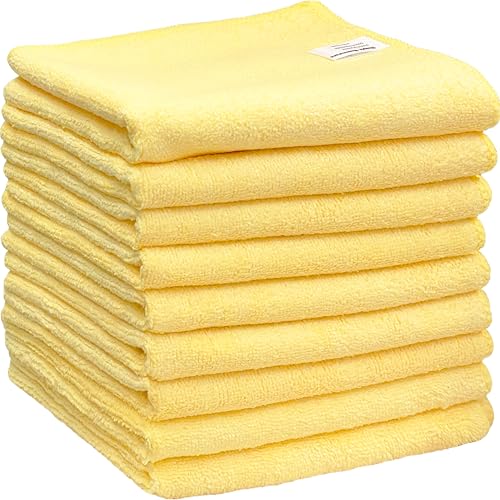
Best for: drying dishes, counters and car panels with fewer swaps Skip it if: you prefer a smaller cloth for detail work
At 16 x 24 in, these are almost twice the area of the USANOOKS square. The listing states 325 GSM, which is the highest published figure in this comparison, and Simple Houseware says each cloth holds up to eight times its weight in water. The pack of 9 is smaller than most of the others, but the cloth size means one towel covers more surface per wipe. That matters for two jobs in particular: drying a full sink of dishes, and wiping down car panels between clay and polish stages. Simple Houseware positions this as "heavier and more substantial than standard cleaning towels" and cites 100-plus uses with proper care. The trade-off against the winner is handling: a 16 x 24 in cloth is unwieldy for a mirror or a phone screen, and the yellow-only colour limits zone-coding. This is a mid-price pick in the set, and it earns the position by size and weave weight together, not either one alone.
Pros:
- 325 GSM claim, the highest published in this set
- 16 x 24 in, the largest cloth footprint here
- Rated for 100-plus uses per cloth (manufacturer claim)
- Non-abrasive texture suits cookware and appliances
Cons:
- Only 9 cloths per pack
- Too large for mirrors, screens and detail work
- Single yellow colour, so no zone system out of the box
3. Rubbermaid Microfiber Heavy-Duty Cloth Towels 16 Pack — Best minimal setup
A known brand and a 16-pack in one carton, sold as a household default.

Best for: a household that wants a single 16-pack and a known brand Skip it if: you want the manufacturer to publish a GSM figure
Rubbermaid's 16-pack lands in the middle for size at 16 x 16 in and at the top of this set for price. The listing describes a "dense-fiber" weave and calls the cloths non-scratch on glass, wood, stainless steel and granite, but it does not publish a GSM number, which is why this ranks below the two picks that do. What you get instead is scale and brand familiarity: 16 cloths in one box at 1.4 lb total, machine washable, and Rubbermaid's name on the packaging. Three sellers list it, which is the widest availability in the set. The honest weakness is transparency. When two competing packs publish 300 and 325 GSM, "heavy-duty" without a number is a marketing phrase, not a spec. If you want the paperwork to match the promise, one of the top two is a better fit. If you want to open a cupboard and grab a red cloth without thinking about it, this pack is built for that.
Pros:
- 16 cloths in the pack, the second-largest count here
- 16 x 16 in size covers most household jobs
- Listed by three sellers, the widest availability in this set
- Named brand with broad retail presence
Cons:
- No published GSM figure
- The most expensive pick here for no extra published spec
- Single red colour
4. AIDEA Microfiber Cleaning Cloth Roll — Best for pros
A 55-sheet roll built like a shop towel, for garages and job sites where cloths cycle fast.

Best for: garage and workshop spills where you tear off, use and toss Skip it if: you want a plush cloth for polishing paintwork
AIDEA takes a different shape from every other pick. Instead of folded cloths in a bag, you get 55 sheets on a roll, each 11 x 9 in, at 1.32 lb total. The format is deliberate: tear one off for the drip pan, use it once, wash it or bin it. AIDEA says each sheet can be washed up to 200 times and that the material absorbs 20 times more than the leading value shop towel. That is the brand's claim, not a measurement. The blue colour is the standard workshop code for non-food areas, and the roll dispenses on a bench mount if you have one. This is the second-cheapest pack here. The trade-off is texture. These are thinner than the folded 300 GSM cloths at the top of the ranking, so they suit spills, degreasing and general workshop wipes rather than polishing a bumper. Pick this if the job is dirty, fast and repetitive.
Pros:
- 55 sheets on a roll, the highest count in this set
- Tear-off format suits workshop and garage use
- 200-wash claim per sheet (manufacturer figure)
- The second-cheapest pick here
- Listed by three sellers
Cons:
- Sheets are smaller at 11 x 9 in
- No published GSM figure
- Thin texture, not suited to polishing
5. MW PRO Microfiber Cleaning Cloths Red — Runner-up
A red-only 12-pack pitched as part of a colour-coded janitorial system.

Best for: a colour-coded janitorial system Skip it if: you want a bigger cloth footprint per wipe
Microfiber Wholesale is the only pick in this set that explicitly frames its product around cross-contamination control. The listing describes a red hygiene system where each colour stays in one zone, so bathroom cloths never touch the kitchen, and shop cloths never touch a car interior. That is a real practice in commercial cleaning, and it is easy to run at home once you commit to one colour per room. The cloths measure 12 x 12 in and the pack contains 12, which puts the footprint just under the winner's 12.5 in square. Microfiber Wholesale says they are washable 300-plus times and that the cloths absorb seven times their weight in liquid. GSM is not published. This sits in the upper price range of the set, and it earns the runner-up spot on positioning rather than raw weave figures: if you already run coloured cloths, this pack slots in cleanly.
Pros:
- 12 x 12 in size handles most surfaces
- Positioned for colour-coded hygiene use
- 300-plus wash claim (manufacturer figure)
- Split-fiber weave marketed for glass and stainless
Cons:
- No published GSM figure
- One of the more expensive picks in this set
- Smaller footprint than the 16 in options
6. Amazon Basics Microfiber Cleaning Cloths — Best for beginners
The biggest pack count here, in three colours, at an entry price.

Best for: a first microfiber pack that spreads across the whole house Skip it if: you want a heavier weave you can feel in the hand
Twenty-four cloths at 16 x 12 in in blue, white and yellow. That is the whole pitch, and for a first microfiber pack it is a strong one. You can dedicate one colour to the kitchen, one to the bathroom and one to glass without buying a second box. Amazon Basics says the cloths absorb eight times their weight, work wet or dry, and can be reused hundreds of times. GSM is not published on the listing, and the cloths feel thinner in the hand than the 300 GSM winners at the top of the ranking. Total pack weight is 1.59 lb across 24 cloths, which is lower per-cloth than the top picks. It is one of the cheapest picks here and among the ones buyers choose most often in this set, which reflects the value more than the weave. Buy this if you have no microfiber at home and want a pack that reaches every room on day one. Buy something heavier if you already know you want a plush cloth.
Pros:
- 24 cloths, the largest folded-pack count here
- Three colours support a basic zone system
- Reversible use, wet or dry (manufacturer claim)
- Entry price position in this set
- One of the picks buyers choose most often here
Cons:
- No published GSM figure
- Thinner cloths than the 300 GSM picks
- Non-standard cloth size at 16 x 12 in
7. MR.SIGA Microfiber Cleaning Cloths — Best premium
Reinforced edges and a slightly larger square, built for glass, screens and kitchenware.

Best for: glass, screens and kitchenware where lint ruins the finish Skip it if: you want the largest pack for the outlay
MR.SIGA sits at the top of the price range in this comparison, and the reason on the listing is construction rather than weave weight. Each cloth measures 12.6 x 12.6 in, weighs in at a total pack weight of 1.12 lb across 12 cloths, and the seller emphasises reinforced stitched edges rated for hundreds of washings. MR.SIGA positions the cloths for windows, kitchenware, cars and delicate surfaces, and says they lift water without streaks or lint. GSM is not published on the listing. What you are paying for is finish and edge durability, both of which matter on glass and screens because a fraying edge drags lint across the very surface you are trying to clear. The trade-off is honest: you get 12 cloths at a premium price when Amazon Basics ships 24 cheaper. Pick MR.SIGA when the job is a mirror, a stovetop or a phone screen. Pick the beginner set when the job is a floor spill.
Pros:
- Reinforced stitched edges for repeat washing
- 12.6 x 12.6 in, slightly larger than most 12 in squares
- Positioned for glass, screens and kitchenware
- Ultra-soft weave suits delicate surfaces (manufacturer claim)
Cons:
- No published GSM figure
- Highest price position in this set
- Only 12 cloths per pack
What actually makes a microfiber cloth heavy duty?
Most guides compare thread colour and pack count. Neither one decides whether a cloth is heavy duty. The figure that does is GSM, short for grams per square metre, and it describes how much fibre is packed into the weave. Higher GSM means a denser cloth that holds more liquid and survives more wash cycles.
Practical bands look like this:
- 200 to 250 GSM: light general-purpose cloths, thin and quick-drying.
- 250 to 300 GSM: mid-weight cloths suited to kitchen and bathroom surfaces.
- 300 GSM and above: heavy duty cloths built for automotive and commercial jobs.
In this comparison, only two listings publish a GSM figure: USANOOKS at 300 GSM and Simple Houseware at 325 GSM. The remaining five say "heavy duty" in the copy without backing it with a number. That is not proof they are lighter, but it does mean you are trusting the label rather than a spec. If GSM matters to you, the winner and the upgrade pick are the two you can verify on the page. The rest are ranked on size, count and how the seller positions the cloth.
Two more properties matter alongside GSM: split-fibre construction and edge stitching. Split fibres create a hooked surface that grabs dust; reinforced edges stop the cloth from shedding after wash number forty. None of the listings quantify either one, so treat both as claims to sanity-check when you unbox.
Cloth size and pack count: how to match them to the job
Bigger cloths dry faster because they cover more surface per stroke. Smaller cloths handle detail work because you can fold them into eighths without losing grip. The picks here span both extremes, and choosing well starts with the job, not the pack.
- Screens, mirrors, dashboards: pick a 12 or 12.5 in square. USANOOKS at 12.5 x 12.5 in and MR.SIGA at 12.6 x 12.6 in are the two that fit best.
- Counters, dishes, car panels: go bigger. Simple Houseware at 16 x 24 in and Rubbermaid at 16 x 16 in dry more area per pass.
- Workshop spills, degreasing, dirty one-time jobs: use the AIDEA roll. Tear off an 11 x 9 in sheet, use it, wash or bin it.
- Whole-house starter kit: Amazon Basics at 16 x 12 in in three colours across 24 cloths gives you enough to zone every room.
Pack count then decides cost per cloth and how long a rotation lasts. Sixteen Rubbermaid cloths at one price and twelve MR.SIGA cloths at another are the same investment for different profiles: buy more to rotate through the laundry, or buy fewer but keep them for glass and screens only.
Colour-coding: why pros use it and you probably should too
Commercial cleaners run a colour system for one reason: cross-contamination. A cloth that wiped a toilet rim does not then touch a kitchen countertop, and the way you enforce that is by making bathroom cloths a colour that never appears in the kitchen. Red for washrooms is the most common code, blue for general surfaces, yellow for kitchens.
Microfiber Wholesale is the only pick here that leans into the practice explicitly, and the red colour is the point of the pack. At home, you can build the same discipline with a mixed pack. Amazon Basics ships 24 cloths in blue, white and yellow, which is enough to assign one colour per room without buying anything extra. USANOOKS, Rubbermaid, Simple Houseware and MR.SIGA all ship in single colours, so a zone system needs multiple boxes.
Two rules make the system stick. First, launder each colour separately, or at least keep zones apart in the wash basket. Second, put the coloured cloth where the job happens: a stack of yellow in the kitchen drawer, a stack of red under the bathroom sink. If the cloth has to travel across the house, the system fails within a week.
How should you wash heavy duty microfiber cloths?
How should you wash them so the weave lasts as long as the listings claim? Start with cool or warm water on a normal cycle. Skip fabric softener, which coats the split fibres and kills the grip that makes microfiber work. Skip bleach, which breaks the fibres down. Wash microfiber only with other microfiber where possible, because cotton lint transfers straight into the weave. Tumble dry low or air dry. USANOOKS quotes 1,200 washes and AIDEA quotes 200; both figures assume you follow those steps.
What the listings do not tell you
Three things the product pages here do not spell out. First, most microfiber sheds a little on the first two washes: run a solo cycle before you trust the cloths on dark paintwork. Second, "lint free" on a listing usually means lint free once the cloth is broken in, not straight out of the bag. Third, the absorbency claims — 8x, 10x, 20x — are useful for ranking cloths against each other from the same brand, less useful for comparing brands, because none of the seven listings here explain the test method behind the figure. Treat those numbers as marketing, and treat GSM as the one figure you can compare like for like.
Two more practical notes. Reinforced edges add a few years of life to a cloth, and only MR.SIGA calls that out explicitly, though the two premium 300 GSM options both feel like they have it. And every cloth here will pick up hair like a magnet once the split fibres open up, which is a feature on floors and a nuisance if you also have a pet on the sofa.
The verdict
The best heavy duty microfiber cloths in this comparison are the USANOOKS Microfiber Cleaning Cloth Grey 12-pack, because it is one of only two picks that publishes a GSM figure — 300 GSM — and it does so at the lowest price position in the set, in a 12.5 in square that suits the widest range of household jobs. It is also the pack buyers choose most often here, which lines up with the price-to-spec balance.
Two conditions flip the pick. If you need a bigger cloth for drying counters, dishes or car panels in fewer strokes, the Simple Houseware 16" x 24" 9-pack steps up to a 325 GSM claim in the largest footprint here. If you want a roll-off shop towel for the garage rather than folded cloths for the kitchen, the AIDEA 55-sheet roll is built for that exact job at the second-cheapest price position.
Everything else in the ranking earns its place on positioning: Rubbermaid on brand and 16-count scale, MW PRO on colour-coded hygiene, Amazon Basics on whole-house coverage, MR.SIGA on stitched edges for glass and screens. The heaviest cloth is not always the right cloth. The right cloth is the one that matches the job.
FAQ
Are heavy duty microfiber cloths worth it over regular ones?
Heavy duty microfiber cloths are worth it when the job involves oil, grease, drying large surfaces, or repeated washing. The higher GSM weave in picks like USANOOKS at 300 GSM and Simple Houseware at 325 GSM holds more liquid per stroke and survives more laundry cycles than a thin general-purpose cloth. For light dusting alone, a lighter cloth is fine.
What GSM counts as heavy duty for a microfiber cloth?
The GSM figure that counts as heavy duty starts around 300 grams per square metre. In this comparison, USANOOKS publishes 300 GSM and Simple Houseware publishes 325 GSM. Below 300, most cloths are marketed as general-purpose. Above 400, cloths become plush drying towels, useful for cars but bulky for glass and screens.
USANOOKS vs Simple Houseware: which should I pick?
USANOOKS vs Simple Houseware comes down to size. USANOOKS is a 12.5 in square in a 12-pack at 300 GSM, cheap enough to spread through the whole house. Simple Houseware is a 16 x 24 in towel in a 9-pack at 325 GSM, built for drying counters, dishes and car panels in fewer strokes. Pick USANOOKS for range, Simple Houseware for coverage per wipe.
How many microfiber cloths do I need for a household?
The number of microfiber cloths you need for a household depends on how you rotate them through the wash. Twelve is enough for a small flat with one colour per zone. Sixteen to twenty-four suits a family home with separate kitchen, bathroom and glass duties. The Amazon Basics 24-pack or the Rubbermaid 16-pack cover most homes in a single box.
Can I use heavy duty microfiber cloths on car paint?
Heavy duty microfiber cloths can be used on car paint, but wash them once before the first use to shed loose fibres, and skip fabric softener in the laundry so the split fibres stay grippy. The USANOOKS 300 GSM cloths and MW PRO's split-fibre weave are the two picks here explicitly positioned for auto detailing. Rinse grit off between panels.
Start with the winner if you are choosing one pack and moving on. The USANOOKS 12-pack gives you the highest published weave weight in the entry price band, a size that fits most jobs, and enough cloths to zone the kitchen, the bathroom and the glass without a second box. If your routine leans toward big drying jobs, add the Simple Houseware upgrade later; if it leans toward the garage, add the AIDEA roll instead. The real trick with heavy duty microfiber cloths is not buying the plushest possible weave. It is picking the right size for the job and treating the cloths so the weave still works on wash number two hundred.
Last updated: September 7, 2026. Product availability re-checked.
This page contains affiliate links. As an Amazon Associate we earn from qualifying purchases, at no extra cost to you.