Best Mold Killer for Drywall: The Basement Fix
Five mold products lined up for drywall work, ranked by whether you plan to repaint, seal, or just clean the stain and move on.
The best mold killer for drywall is Concrobium Mold Control, a 32 fl oz bleach-free spray that treats mold at the source and leaves an invisible barrier the listing says helps prevent regrowth. If you plan to repaint the wall afterward, Zinsser Mold Killing Primer is the smarter buy, since it kills existing mold and seals in one coat. Drywall is porous, which changes the math. That single fact splits this field cleaner than any specification.
How I screened these five for drywall use
I lined up five 32 fl oz products and judged them against one criterion: what happens when mold sits on a porous surface like drywall paper. Three named reasons cut a product from serious contention here.
- No mold-control claim. A stain remover that brightens the surface but leaves nothing behind fails the porous test. Mold roots into drywall paper, so lifting the visible stain isn't the same as stopping the growth.
- Nonporous-only labeling. Two picks state their formula works on hard, nonporous surfaces. Drywall is neither hard nor nonporous, so that language matters.
- No repaint path. For anyone finishing a wall, a product that can't be painted over adds a step. The primer here solves that directly.
What survived is a spread of approaches:
- Concrobium, an EPA-registered spray that lists drywall by name
- Zinsser, a fungicidal primer that kills and seals together
- 30 SECONDS Pro, a fast stain lifter that lists drywall among its surfaces
- The RMR Brands kit, a two-bottle killer-plus-remover bundle
- Moldex, a bleach-free disinfectant built for nonporous surfaces
None of these is a substitute for fixing the moisture that caused the mold. Every serious drywall job starts there.
Best mold killer for drywall at a glance
| Pick | Approach | Drywall-listed? | Price |
|---|---|---|---|
| Best overall Concrobium Mold Control |
Spray, seals surface | Yes, listed | Check Price |
| Runner-up Zinsser Mold Killing Primer |
Primer, kills + seals | Wall cavities, walls | Check Price |
| Best premium 30 SECONDS Pro Mold & Mildew |
Spray, stain lift | Yes, listed | Check Price |
| Best large-capacity RMR Brands DIY Bundle |
Two 32 oz bottles | Not listed | Check Price |
| Best budget pick Moldex Mold Killer |
Spray, nonporous | Nonporous only | Check Price |
Why the drywall question changes everything
Drywall is a porous surface. That is the single fact most mold-killer guides skip, and it decides which of these picks actually earns your money.
Here's the trick. Most sprays are labeled for hard, nonporous surfaces: tile, grout, sealed concrete, glass. On those, mold sits on top and wipes away. Drywall paper is different. Mold roots into the fibers, so a surface cleaner can brighten the face while the growth continues underneath. That's why two of these five, despite being solid products, aren't the right pick for the drywall face itself.
The keyword you searched carries a qualifier the Amazon results only partly satisfy. Some of these products name drywall directly. Others don't, and you have to judge each label yourself. I've flagged which is which in the table above and in every product section below. Don't assume a mold killer works on drywall just because it kills mold. Check that the listing names the surface, and confirm the drywall is still structurally sound. Soft or crumbling board needs replacement, not spray.
1. Concrobium Mold Control — Best overall
Concrobium is the best mold killer for drywall because it names the surface, skips the bleach, and claims to leave a barrier that prevents regrowth.

Best for: sealing porous drywall and preventing regrowth without bleach Skip it if: the surface is soft or crumbling and needs replacement
What sets Concrobium apart in this set is the combination of claims. It's EPA-registered for mold control when used as directed, and the listing names drywall, wood, tile, grout, concrete, and fabric among safe surfaces. That surface list matters more than any number here. The formula is bleach-free, ammonia-free, and stated VOC-free, which the brand ties to keeping indoor air quality healthy in enclosed spaces like basements and attics.
The bottle holds 32 fl oz and weighs 2 lb, with a slim 10.7 x 2.6 x 4.6 in profile that fits a supply shelf. Concrobium says it targets existing mold at the source and dries to an invisible barrier that helps prevent future growth. On drywall, that dual action is exactly what the porous surface demands: kill what's there, discourage what's next.
The trade-off against the primer runner-up is finish. Concrobium treats and protects, but it doesn't leave paintable coverage. If you're repainting the wall, you'll want the primer instead.
Pros:
- EPA-registered for mold control as directed
- Names drywall explicitly among safe surfaces
- Bleach-free, ammonia-free, stated VOC-free
- Claims an invisible barrier against regrowth
- Slim bottle at 2 lb, easy to store
Cons:
- No paintable finish for repaint jobs
- Won't rescue soft or crumbling board
- Sells slower than the top mover in this set
2. Zinsser Mold Killing Primer — Runner-up
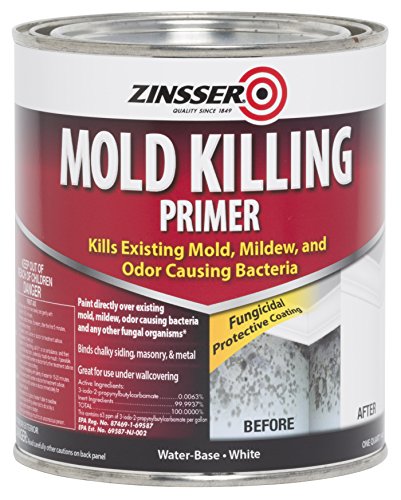
Zinsser is the pick for anyone repainting, because it kills existing mold and lays down a paintable coat in one step.
Best for: anyone repainting drywall after the mold is gone Skip it if: you don't plan to paint over the treated area
Zinsser is the only pick here that solves the finish problem. It's a water-based fungicidal protective coating, EPA-registered under Reg. No. 87469-1-69587, and the brand says it kills existing mold, mildew, and odor-causing bacteria without extensive pre-cleaning. For a drywall repair headed for fresh paint, that collapses two jobs into one.
The listing points at wall cavities, window frames, basements, and bathrooms, which is drywall territory. Zinsser says you can paint directly over existing mold and mildew, with the important caveat printed on the label: fix all moisture issues first, and refer to remediation guidelines for structurally unsound surfaces. This white 32 fl oz coating is designed to work under any topcoat and to cover fungal stains, and the brand pairs it with its Perma-White finish.
There's a warranty noted on the listing, which not every pick here carries. The trade-off is scope. This is a primer, not a general cleaner, so it earns its place only when a fresh coat of paint is part of the plan. Spray it on a wall you don't intend to paint and you've bought the wrong tool.
Pros:
- Kills mold and seals in one coat
- EPA-registered with a listed registration number
- Paintable under any topcoat
- Names wall cavities and basements
- Warranty noted on the listing
Cons:
- Only makes sense if you're repainting
- Requires fixing moisture issues first
- Not a wipe-and-rinse surface cleaner
3. 30 SECONDS Pro Mold & Mildew Stain Remover — Best premium
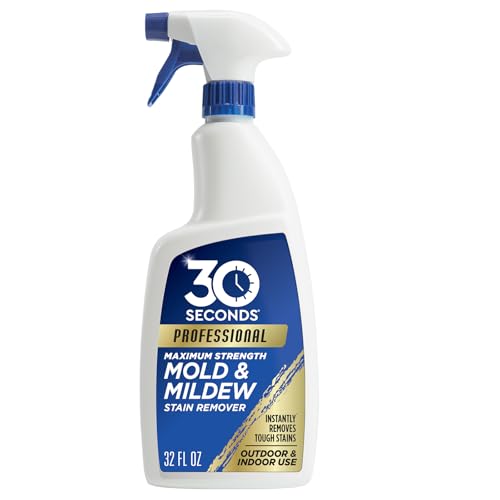
The 30 SECONDS Pro formula lifts black stains fast, and its surface list includes drywall, but stain removal isn't the same as mold control.
Best for: fast stain lifting on tile, grout, and painted walls Skip it if: you need EPA-registered mold control on bare drywall
This is the fastest mover in the set and the one buyers reach for most often here. The 30 SECONDS Pro formula is built for speed: the brand says it removes black mold and mildew stains as you watch, with no scrubbing or pressure washing. It calls the PRO formula 2X stronger than its standard outdoor cleaner, aimed at the toughest black stains indoors and out.
The 32 fl oz bottle weighs 2.2 lb, the heaviest liquid spray here, and the surface list does name drywall alongside siding, decks, brick, wood, tile, grout, and showers. So why isn't it the overall winner for drywall? The listing frames it as a stain remover, not a mold-control product with an EPA registration or a stated regrowth barrier. On a porous wall, lifting the stain is only half the problem.
Where it shines is anything nonporous and stained near the drywall: bathroom tile, grout lines, painted surfaces. It's the priciest spray here, which is why it lands as the premium pick rather than the value one. Buy it for speed on stains, not for treating the wall's roots.
Pros:
- Lifts black stains without scrubbing
- Brand claims 2X strength over its standard formula
- Names drywall among many surfaces
- The one buyers choose most often here
Cons:
- Framed as a stain remover, not mold control
- No stated EPA registration or regrowth barrier
- The most expensive spray in this set
4. RMR Brands DIY Mold & Stain Remover Bundle — Best large-capacity
The RMR bundle gives you the most liquid in the set, pairing a disinfectant fungicide with a dedicated stain remover.

Best for: big cleanups needing both a killer and a stain remover Skip it if: you only have one small patch to treat
This is the only two-bottle pick, and it carries the most product: a 32 Fl Oz Pack of 2, 4 lb total, in a 12 x 7 x 3.5 in box. The bundle pairs RMR-141 RTU, which the brand calls a disinfectant spray cleaner and fungicide that kills mold and mildew and prevents regrowth by eliminating roots, with RMR-86, an instant stain remover for the marks left behind.
That split is the appeal. One bottle to kill, one to erase. For a large basement or a whole-room cleanup, having both on hand saves a second shopping trip. The brand says both are ready-to-use, no scrubbing required, and lists wood decks, concrete, brick, kitchen tiles, and carpeted areas among surfaces.
Here's the catch for your search: this listing does not name drywall. It leans toward decks, concrete, and tile. That doesn't mean it can't help around a drywall job, but you'd be judging the label yourself rather than following an explicit surface claim. It's also the priciest pick overall and the slowest seller of the five. Buy it for volume and the two-step approach, not because it promises drywall by name.
Pros:
- Most liquid in the set, two 32 oz bottles
- Separate killer and stain remover
- Both ready-to-use, no scrubbing claimed
- Good value per ounce for large jobs
Cons:
- Drywall not named on the listing
- Highest price position in the set
- The slowest seller of the five
- Bulkier 12 x 7 x 3.5 in box to store
5. Moldex Mold Killer — Best budget pick
Moldex is the cheapest of the five and a capable disinfectant, but its formula is stated for hard, nonporous surfaces, not the drywall face.

Best for: hard, nonporous surfaces near the drywall Skip it if: you need it to work on the drywall face itself
Moldex is the value entry: the cheapest of the six and the lightest at 1 lb in a compact 7.9 x 2.6 x 2.6 in bottle. It's an EPA-registered, bleach-free, ready-to-use spray that cleans, deodorizes, and disinfects in one pass, and the brand says it leaves a fresh scent behind. A warranty is noted on the listing.
The reason it lands last for a drywall search is spelled out in its own claims. Moldex states it kills mold and helps control mold and mildew on hard, nonporous surfaces when used as directed. Drywall paper is porous, so the label is pointing you elsewhere. That's not a knock on the product, it's a match problem.
Where Moldex fits is the tile, sealed trim, fixtures, and painted nonporous areas around a moldy wall. As a low-cost disinfectant for those zones, it does the job without bleach and without the price of the premium picks. Its trade-off against the winner is exactly the surface question: Concrobium names drywall, Moldex names nonporous. For the wall itself, that difference decides it.
Pros:
- Cheapest pick in the set
- Lightest bottle at 1 lb
- EPA-registered, bleach-free, ready-to-use
- Warranty noted on the listing
Cons:
- Labeled for nonporous surfaces only
- Not matched to the drywall face
- Slower seller than the top picks
Spray, primer, or two-step kit: which fits your job?
Three formats sit in this set, and they suit three different jobs. Pick the format first, then the product.
- A treatment spray like Concrobium is the default. You spray, let it work, and it treats the surface without a topcoat. Best when you're not repainting.
- A primer like Zinsser kills and seals in one coat, so it only makes sense when fresh paint follows. It's the finish-line tool.
- A two-step kit like the RMR bundle separates killing from stain removal, which shines on large jobs where you'll do both anyway.
The stain-lift sprays, 30 SECONDS Pro and to a degree the RMR-86 bottle, are about appearance. They make the mark disappear. That's satisfying, but on porous drywall it can hide an ongoing problem. Match the format to whether your goal is to clean, to prevent, or to finish, and the right product falls out of that choice quickly.
What the listings won't tell you about porous surfaces
Every one of these listings talks about surfaces, but none of them fully answers the question a drywall owner actually has. Here's what to check yourself before you buy.
- Is the board still solid? Zinsser's own label says structurally unsound surfaces need remediation, not primer. If drywall is soft, sagging, or crumbling, cut it out and replace it.
- Where did the water come from? No spray or primer here fixes a leak. Concrobium and Zinsser both work on the assumption the moisture source is handled first.
- Nonporous versus porous. Moldex names nonporous surfaces. Concrobium names drywall. That wording is the difference between a product built for your wall and one built for the tile beside it.
- Stain gone versus mold gone. A brightened surface can still hide living growth in the paper. Stain removers address the mark, not the root.
Read the surface list on any mold product against the exact material you're treating. The best mold killer for drywall is the one whose own label says drywall.
When a different pick wins
The winner flips under three concrete conditions. Match yours.
- If you're repainting the wall, Zinsser wins outright. Killing and sealing in one coat beats a separate treatment plus a separate primer every time.
- If the mess is on tile, grout, or painted trim rather than the drywall face, 30 SECONDS Pro's fast stain lift is the better tool, and the material's nonporous surface plays to its strength.
- If you're clearing a whole basement and want both a killer and a stain remover on hand, the RMR bundle's 4 lb of product across two bottles saves the second trip.
The cutoff is the surface and the finish. Bare porous drywall you won't paint: Concrobium. Drywall you will paint: Zinsser. Nonporous surfaces nearby: the sprays. Once you know which of those describes your wall, the pick is obvious.
The verdict
If you're treating bare drywall and not repainting, the best mold killer for drywall is Concrobium Mold Control. It's the only spray here that names drywall on its label, it's EPA-registered for mold control, and it's bleach-free and stated VOC-free, which matters in a closed basement or attic. The claimed invisible barrier addresses the real drywall problem: stopping regrowth in porous paper, not just wiping the surface.
If you're repainting, the pick changes. Zinsser Mold Killing Primer kills existing mold and lays down a paintable coat in one step, EPA-registered and built for wall cavities and basements. Its exact advantage over Concrobium is the finish: it leaves a surface ready for topcoat, collapsing two jobs into one. Concrobium can't do that.
The cutoff between them is simple. No paint follows, choose Concrobium. Paint follows, choose Zinsser. The 30 SECONDS Pro spray is the fastest stain lifter but is framed for cleaning, not control. Moldex is the cheapest and a fine nonporous disinfectant, and the RMR bundle gives you the most volume. None of them beats matching the label to your wall.
FAQ
Is Concrobium worth it for a small mold patch on drywall?
Concrobium is worth it for a small patch because it's the pick that names drywall on its label and claims to leave a regrowth barrier. The 32 fl oz bottle covers many small jobs, and being bleach-free and stated VOC-free makes it easier to use in a closed room. For one stain on porous board, that surface match is what you're paying for.
Which is better for drywall, Concrobium or Zinsser primer?
Better for drywall depends on whether you're repainting. Concrobium is a treatment spray that names drywall and seals against regrowth without a topcoat, so it wins when no paint follows. Zinsser is a primer that kills mold and lays down a paintable coat in one step, so it wins when you're finishing the wall. Same wall, different endgame decides it.
Do I need an EPA-registered mold killer for drywall?
An EPA-registered mold killer for drywall gives you a formula the manufacturer states works for mold control when used as directed. Concrobium, Zinsser, and Moldex all list EPA registration here. 30 SECONDS Pro is framed as a stain remover instead. If your goal is controlling mold rather than just erasing the mark, the EPA-registered picks are the safer choice on porous board.
Can these mold killers work on porous drywall surfaces?
Working on porous drywall surfaces depends entirely on the label. Concrobium names drywall directly, and Zinsser targets wall cavities and walls. Moldex, by contrast, states it works on hard, nonporous surfaces, and the RMR bundle doesn't name drywall at all. Porous drywall paper lets mold root deeper, so choose a product whose own listing names the material you're treating.
What's the biggest mistake buyers make with drywall mold?
The biggest mistake buyers make is treating the stain and ignoring the water. No spray or primer here fixes a leak, and a brightened surface can hide living growth in the paper. Confirm the board is still solid, since Zinsser's own label says unsound surfaces need remediation. Fix the moisture first, then kill the mold, then seal or paint.
Start by checking the label on whatever mold product you're eyeing against the exact surface you're treating, because that one line decides more than any price or feature claim. For bare drywall you won't repaint, Concrobium Mold Control is the safe default: it names the surface, carries an EPA registration, skips the bleach, and claims to guard against regrowth in the porous paper where mold actually lives. Fix the moisture source first, confirm the board is sound, then treat. Match the tool to the wall and the job gets simpler.
Last updated: September 7, 2026. Product availability re-checked.
This page contains affiliate links. As an Amazon Associate we earn from qualifying purchases, at no extra cost to you.